

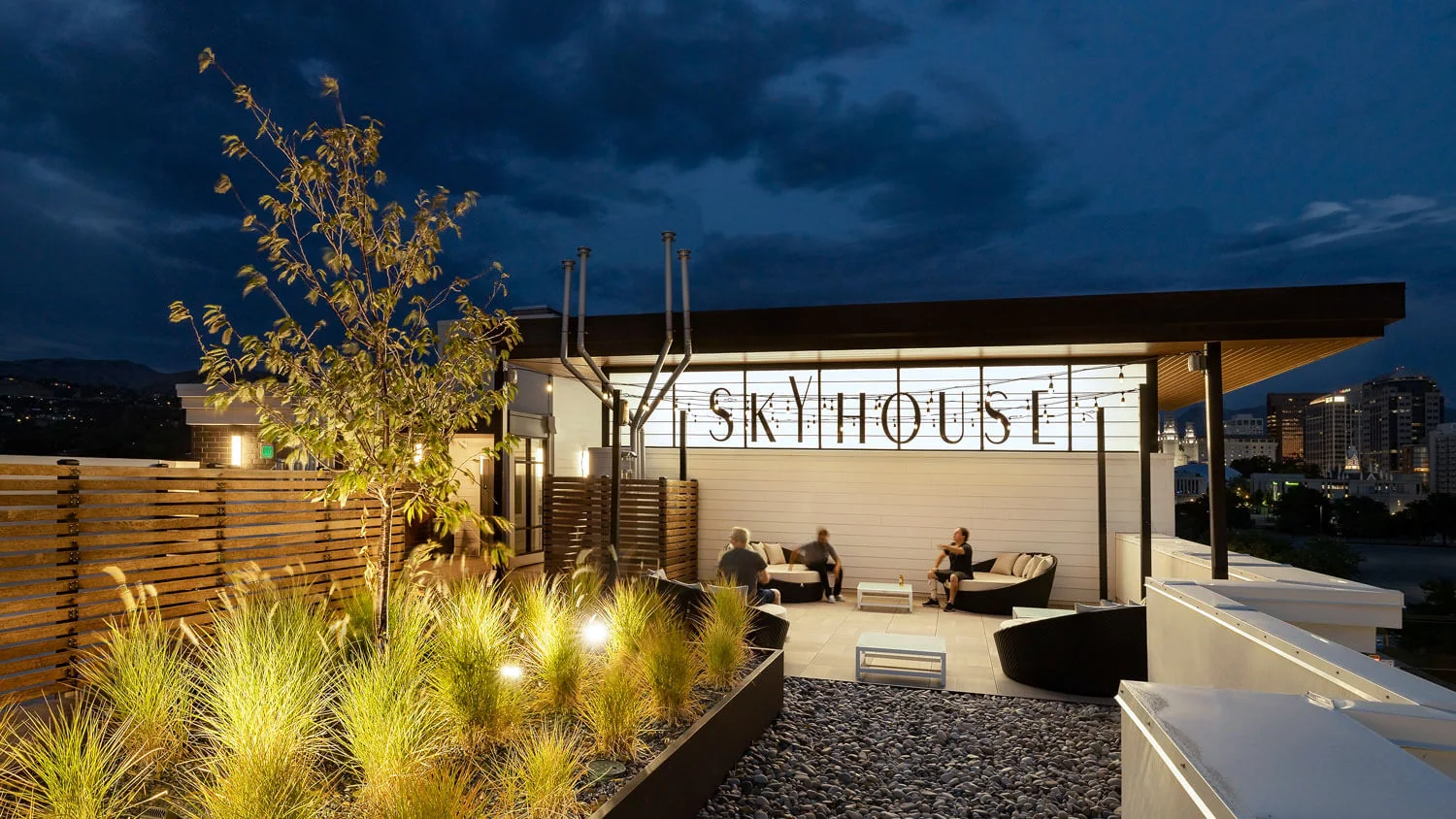
For almost a decade, we’ve observed rooftop amenities evolve from an uncommon luxury to a standard feature for all urban multifamily developments. And we’ve written nonstop about the benefits of rooftop amenities — for both residents and your bottom line.
There’s no doubt rooftop amenities are the present and future of urban outdoor living. So you’d assume we’d want to see them on every multifamily project from here on out, right? Well, not exactly.
Not every project is a good fit for rooftop amenities. Rooftop amenities are not just a fleeting trend that will get stamped onto all development projects for a time, only to fade into non-existence. Rather, rooftop amenities are a key part of community-building for the right locations and a feature that you can (and should) strategically avoid when it doesn’t make sense.
Consider these three reasons why you may not want to include rooftop amenities in your next multifamily community:
1. You Don’t Have Enough Units to Justify the Cost
Rooftop amenities have a direct impact on rent, increasing net operating income by hundreds of thousands to millions of dollars each year. But all of this depends on the size of your property. Your unit count and total rentable square footage determine the profitability of your rooftop amenities.
Because residents are willing to pay higher rents for access to rooftop spaces, your income increases by the amount of people who will have access. Simply put, more units equal higher value rooftop amenities. Conversely, if you don’t have enough rental income to offset your operating costs, you simply won’t see any return on your rooftop amenities investment.
While rooftop amenities can produce income beyond increasing unit rent prices, higher rent has the biggest impact.
So, how many units does it take to justify building a rooftop amenity? In our experience, apartment communities with fewer than 50 units will begin to see a diminishing return on investment in rooftop amenities. Meanwhile, those with 200 units or more see the most significant returns. Here’s a breakdown:
- If you have 200 units or more, rooftop amenities are easily, without doubt, worth the investment.
- Between 50 and 200 units you’ll want to be careful about the size and scope.
- With under 50 units you should consider passing on rooftop amenities altogether.
2. Your Building is Not in an Urban Neighborhood
The rise of rooftop amenities has been proportional to the renewed interest in urban living. As American cities house more people, rising land costs push buildings to the lot line, reducing the amount of outdoor space at street level. In an effort to keep urban apartments livable, outdoor space must be provided at the only location available: the roof.
Ironically, the most marketable aspects of rooftop amenities are access to green space and city views. When you’re not building in an urban neighborhood, however, neither of these marketable aspects fully deliver.
Here’s why: There is already ample open space in the suburbs, so access to green space doesn’t feel like a perk, but rather a forgone conclusion. And city views are conspicuously absent from the far-flung sprawl, making the experience of being on a rooftop far less inspiring.
On top of that, your budget may be eaten up elsewhere. If your apartment building is in the suburbs, chances are that zoning regulations and financial constraints prescribe things like large setbacks, water detention areas, and parking lots. You’ll be required to landscape all of these.
Rather than add expensive outdoor space on top of your building, consider amenitizing the outdoor space you’re already required to provide at street level. Make your outdoor amenities front and center. And cater to the suburbanite who favors spread out, garden-style apartment communities over the densely populated urban alternative.
3. Your Project Doesn’t Need to Be A Standout
Not every project has to be a standout. You may be involved in dozens of projects, but maybe only consider a few to be truly special. And that’s okay. After all, if every project were a standout, none of them would be.
Given our country’s housing shortage, just getting some apartments built is a major accomplishment. Whatever the reason, your project may not be competing on the highest level, and therefore not warrant so many amenities. If that’s the case, it makes sense to not go all out on rooftop amenities.
If you know deep down that you’re not committed to investing in rooftop amenities, save yourself the trouble and avoid them in the first place. It’s a better strategy to not include rooftop amenities than to create a sub-par experience that 1) doesn’t sell and 2) nobody uses.
Are Rooftop Amenities Right for Your Project?
If you’re not deterred by these three reasons not to build rooftop amenities, we’re ready to help. At Loft Six Four, we specialize in creating immersive rooftop amenities and outdoor living experiences for large, urban multifamily developments that need to be special and stand out from the crowd.
Got a project or ideas that you want to explore possibilities on? Let’s talk.
Added October 26, 2026
Rooftop amenities in Salt Lake City, against the three tests
The post’s three tests are unit count, an urban site, and whether the building has to stand out. Here are three Salt Lake City buildings with rooftops we designed, and their published unit counts.
| Building | Units | Neighborhood | What’s on the roof |
|---|---|---|---|
| The Randi | 61 | Downtown | Over 4,000 sq ft: grilling and dining spaces, a sun lounge, and a 10-foot communal fire pit |
| Sugar Alley | 193 | Sugar House | An open-air rooftop patio with its own pool and hot tub, above a level-three pool deck |
| 4th West | 450 | West Side | A 26,000 sq ft deck with an Olympic-sized pool, cabanas, and fire lounges |
Units: The Randi and Sugar Alley both sit in the post’s 50 to 200 unit band, where it says to be careful about size and scope. The Randi kept its rooftop just over 4,000 sq ft, and that roof adds an estimated $1 million or more to the property’s value.
Urban site: all three are in Salt Lake City neighborhoods where the skyline and the Wasatch are part of the draw. Out in Holladay, The Grandeur put its pool terrace and infinity spa on the podium, with Mount Olympus in view.
Standing out: Skyhouse came to downtown during a development surge, when plenty of new buildings were leaning on concessions. It put a controlled budget into a 13,000 sq ft rooftop and reached 95% occupancy.
If the roof passes, build all of it
The worst version is a roof that gets approved, then cut down to a railing and a few grills in value engineering. It sells the tour, and then it sits empty.
When costs climbed at The Randi, the rooftop got smaller and the program stayed. We rearranged the design to fit, so residents still got every gathering space on the list. If a roof can’t be done right, the podium may be the better home for the amenity, and our podium amenity deck page covers that path.
Common questions
Rooftop amenity questions before you commit
Are rooftop amenities worth it for a multifamily building?
They can be, when the building has the units, the site, and a reason to stand out. Skyhouse in downtown Salt Lake City reached 95% occupancy with an estimated $425,000 a year in rooftop-driven revenue. Treated as an afterthought, they rarely pay, and a sub-par roof can do more harm than no roof.
How many units does a building need for rooftop amenities?
There’s no hard cutoff. This post suggests passing on a rooftop under 50 units and watching size and scope between 50 and 200. The Randi in downtown Salt Lake City has 61 units, and its rooftop adds an estimated $1 million or more to the property’s value.
What rooftop amenities do Salt Lake City buildings include?
On the Salt Lake City rooftops we’ve designed, water and fire do most of the work. 4th West has an Olympic-sized pool, Park Avenue a 10,000 sq ft pool terrace, and Sugar Alley an open-air rooftop pool and hot tub. Skyhouse and The Randi are built around fire pits, with outdoor kitchens or grilling spaces close by.
Is a podium deck a better choice than a rooftop?
Sometimes. A podium amenity deck sits on structure over a lower level, closer to the units. The Grandeur in Holladay put its pool terrace and infinity spa on a 16,804 sq ft podium (L64 design scope), open year-round with Mount Olympus in view. Post House in Salt Lake City’s Post District has podium pools that work in January as well as July.
Why do some rooftops sit empty?
Usually because they were designed last. The structure, the mechanical units, and the budget get set first, and the roof gets whatever space and money are left. A railing and a few grills with no shade won’t bring people back up. The busy ones were planned with the building, like 4th West, which regularly hosts 500+ residents and guests.
Got a project on the boards in Utah? Call the studio at 801-878-4717.